In the current industrial landscape of 2026, procurement managers face a complex decision when selecting between laser and waterjet cutting for OEM/ODM projects. This choice is no longer just about the physical cut; it is about optimizing the entire supply chain, from material utilization to the landed cost per part. As global manufacturing moves toward tighter tolerances and greener production, understanding the procurement logic behind these two pillars of fabrication is essential for successful supplier evaluation.
| Feature | Laser Cutting (Fiber/CO2) | Waterjet Cutting (Abrasive) |
|---|---|---|
| Primary Advantage | Exceptional speed on thin-to-medium materials | Versatility; cuts almost any material |
| Material Thickness | Best for < 25mm (Fiber) | Best for 25mm to 150mm+ |
| Precision/Tolerance | Extremely high (+/- 0.1mm) | High (+/- 0.2mm) |
| Heat Affected Zone (HAZ) | Yes (requires secondary finishing) | None (cold cutting) |
| Setup Cost | Low to Moderate | Moderate |
| Material Range | Metals, some plastics/woods | Almost everything (Stone, Metal, Glass, Composites) |
| Lead Time | Generally shorter for high-volume | Longer due to slower cutting speeds |
How Do These Technologies Function in a Factory Setting?
Why Is Fiber Laser the Standard for High-Volume OEM?
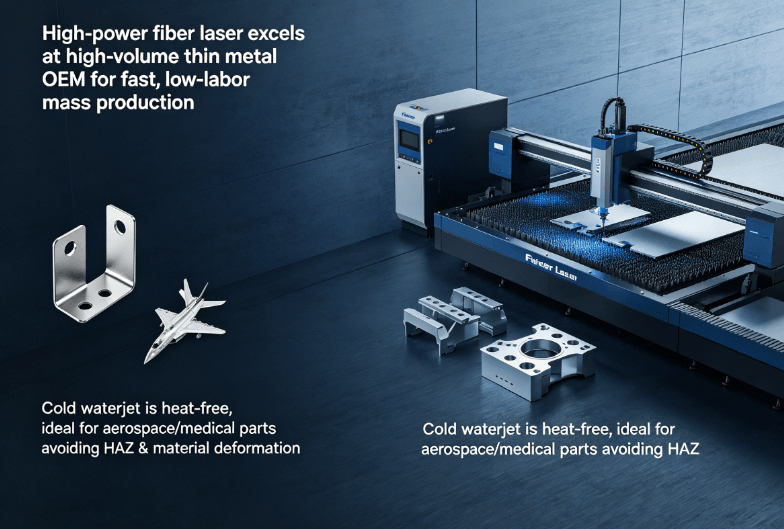
Fiber laser cutting utilizes a high-density light beam focused through a fiber optic cable to melt or vaporize material. By 2026, the industry has seen a massive shift toward ultra-high-power fiber lasers (up to 30kW and beyond) which have bridged the gap in thickness capabilities. From a sourcing perspective, lasers are the "speed kings." They offer rapid-fire production for thin metal sheets, which significantly reduces the labor hours billed by your supplier. If your project involves thousands of stainless steel brackets or aluminum enclosures, a laser-equipped factory will almost always provide the most competitive quote.
When Does Cold-Cutting Waterjet Become Necessary?
Waterjet cutting remains an indispensable tool for procurement because it is a mechanical, non-thermal process. It uses a high-pressure stream of water (up to 90,000 PSI) mixed with abrasive garnet to erode the material. Because there is no heat involved, there is no risk of changing the material’s molecular structure—a critical requirement for aerospace, medical, and high-performance automotive parts. For buyers, the waterjet represents the "versatility tool," capable of cutting everything from 100mm thick steel to delicate glass laminates without the risk of cracking or warping.
Which Materials Dictate Your Choice of Cutting Method?
Which Metals Are Best Suited for Laser Precision?
- Carbon & Stainless Steel: The bread and butter of laser shops. For gauges under 12mm, laser is nearly impossible to beat on price.
- Aluminum: While once difficult due to reflectivity, 2026-era Fiber lasers handle aluminum with ease.
- Thin Plastics: Ideal for enclosures and gaskets (though CO2 lasers are required for certain non-metals).
Why Choose Waterjet for Thick or Reflective Materials?
- Thick Plates: If your project requires steel over 30mm thick, a laser will struggle with edge quality, whereas a waterjet will cut it cleanly.
- Reflective or Heat-Sensitive Metals: Copper and Brass can be tricky for some older lasers. Waterjet eliminates the risk of beam reflection.
- Composites and Laminates: Lasers can cause delamination or release toxic fumes from certain resins. Waterjet’s cold-cutting nature preserves the bond between layers.
- Granite, Glass, and Ceramics: Essential for architectural or specialized industrial components.
How Do Edge Quality and Secondary Costs Impact Your Bottom Line?
Does the Heat Affected Zone (HAZ) Increase Your Finished Part Cost?
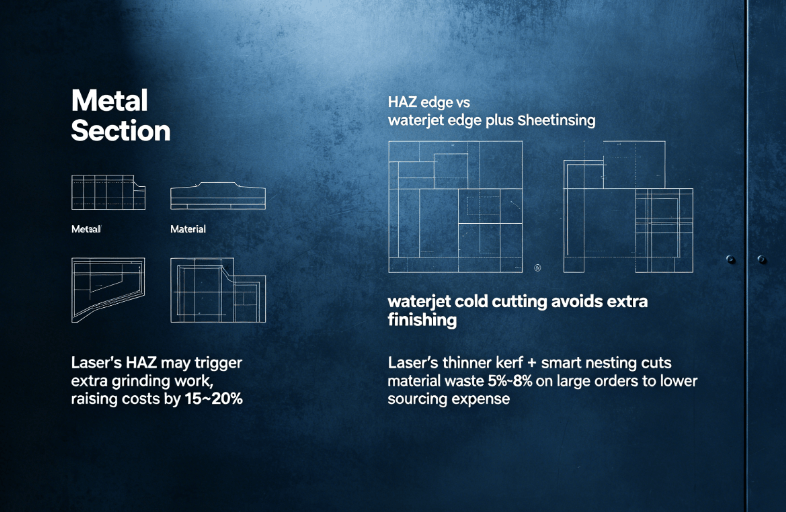
Procurement professionals often overlook the "Hidden Cost of Heat." Laser cutting is a thermal process, meaning the edge of the cut material undergoes a rapid heating and cooling cycle. This creates a Heat Affected Zone (HAZ) where the metal can become hardened or brittle. If your quality control (QC) standards require these edges to be milled or ground down to reach a specific grain structure, you are adding 15-20% to your production cost. Waterjet cutting, being a cold process, leaves a "satin" finish that is often assembly-ready, effectively lowering your Total Cost of Acquisition (TCO).
Can Nesting Efficiency Reduce Your Material Procurement Spend?
In bulk sourcing, material scrap is wasted money. The "kerf" (the width of the cut) is significantly narrower in laser cutting (0.1mm) compared to waterjet (0.7mm to 1.0mm). When your supplier uses AI-driven nesting software to fit parts onto a sheet of expensive alloy, the laser's narrow kerf allows parts to be placed closer together. Over a production run of 10,000 units, this can lead to a 5-8% reduction in raw material consumption—a saving that should be negotiated back into your per-unit price.
What Questions Should You Ask During the Supplier Audit?
When vetting a new fabrication partner in 2026, generic questions are not enough. You must probe into their technological efficiency and workflow.
- "What is the wattage of your Fiber lasers?" (Higher wattage, e.g., 12kW+, means better edge quality on thicker plates).
- "How do you manage garnet disposal and abrasive costs?" (Efficient recycling systems indicate a more cost-competitive waterjet supplier).
- "Do you offer 5-axis cutting?" (Required for complex bevels and 3D shapes).
- "What are your tolerance guarantees for 20mm+ stainless steel?" (Tests their technical understanding of machine drift).
- "Can you provide a grain-structure analysis for heat-sensitive parts?" (Crucial for high-spec industrial quality control).
Which Technology Wins in Real-World Procurement Scenarios?
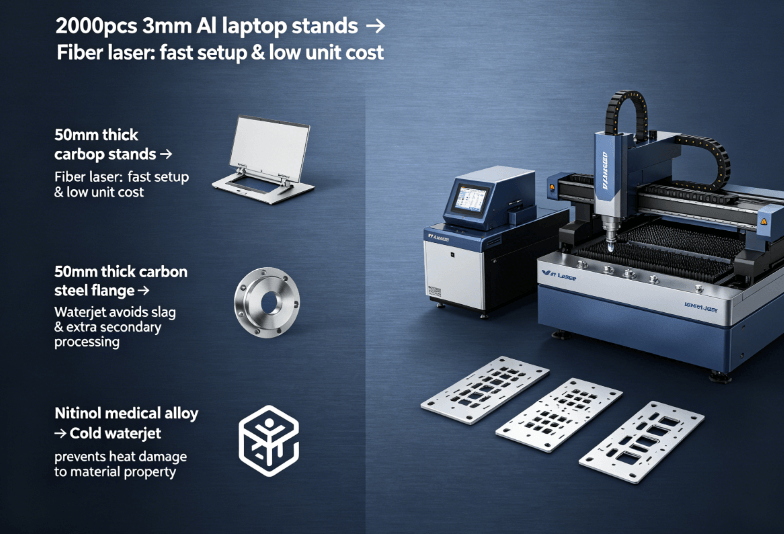
In the first scenario, consider an ecommerce brand owner sourcing custom 3mm aluminum laptop stands. With a volume of 2,000 units, Laser Cutting wins due to its high speed and minimal setup time. The cost per part will be significantly lower because the machine can finish the entire batch in a fraction of the time a waterjet would require.
In the second scenario, an industrial importer needs 50mm thick carbon steel flanges for a pipeline project. Here, Waterjet Cutting is the only viable option. At this thickness, a laser would produce a heavily tapered edge with significant slag (dross) on the bottom, requiring expensive secondary machining. The waterjet provides a clean, vertical cut that meets the strict safety standards of the energy sector.
Finally, for an OEM medical device manufacturer using Nitinol or other "memory alloys," the cold-cutting nature of the waterjet is mandatory. Any heat from a laser would ruin the material's unique properties, leading to a 100% failure rate during inspection.
Summary
Choosing between laser and waterjet in 2026 is a strategic balancing act. Laser cutting is the optimal choice for high-speed, high-volume production of thin to medium metal parts where speed is the primary driver of cost reduction. Waterjet cutting is the superior choice for thick materials, heat-sensitive alloys, and projects where material integrity is a non-negotiable quality metric. For the most resilient supply chain, procurement managers should seek out "hybrid" suppliers who possess both technologies, allowing for flexibility as product designs evolve.
Reference Sources
The Fabricator offers 2026 trends in laser and waterjet.