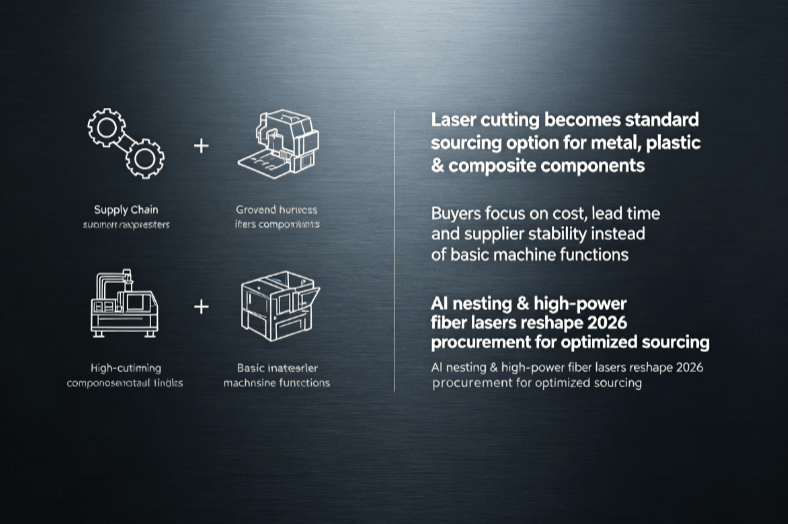
In the rapidly evolving landscape of global manufacturing, laser cutting has transitioned from a specialized high-end service to a fundamental requirement in the procurement of metal, plastic, and composite parts. For sourcing professionals, understanding laser applications is no longer just about knowing "what" a machine does, but "how" specific applications impact lead times, cost-per-part, and supplier reliability.
As we move into 2026, the integration of AI-driven nesting and high-kilowatt fiber lasers has shifted the procurement landscape. This guide provides a deep dive into the current market ecosystem, helping buyers navigate the complexities of laser technology to make informed sourcing decisions.
Understanding the Laser Landscape: Fiber vs. CO2
Before diving into specific industry uses, procurement teams must distinguish between the two primary laser technologies found in modern supplier facilities. This technical distinction dictates which suppliers are suitable for your specific RFQ (Request for Quote).
1. Fiber Laser Applications?
Fiber lasers have become the industry standard for metal fabrication. Using solid-state diodes to create the beam, they are exceptionally efficient for:
- Reflective Metals: High-speed cutting of copper, brass, and aluminum.
- Thin to Medium Sheets: Unmatched speed in stainless and carbon steel under 20mm.
- Low Maintenance Sourcing: Suppliers using fiber lasers typically have lower operational overhead, which can reflect in more competitive unit pricing for high-volume orders.
2. CO2 Laser Applications?
While older, CO2 technology remains vital for non-metallic sectors. It utilizes a gas mixture to generate the beam, making it the primary choice for:
- Organic Materials: Wood, paper, and leather cutting/engraving.
- Polymers: Acrylic and certain plastics where a polished edge finish is required.
- Thick Non-Metals: Applications in the signage and architectural industries.
Sourcing Reality Check: If your product requires intricate metal parts, a supplier still relying solely on CO2 lasers may struggle with your lead time and pricing expectations compared to a fiber-equipped shop.
Key Industry Applications: Where Precision Meets Scalability
The versatility of laser applications spans across diverse industrial sectors. Identifying where your product fits within these applications allows you to target specialized manufacturers rather than generalist shops.
1. Automotive and Transportation Sector?
The automotive sector remains the largest consumer of laser cutting services. Beyond simple chassis parts, laser applications in 2026 focus on:
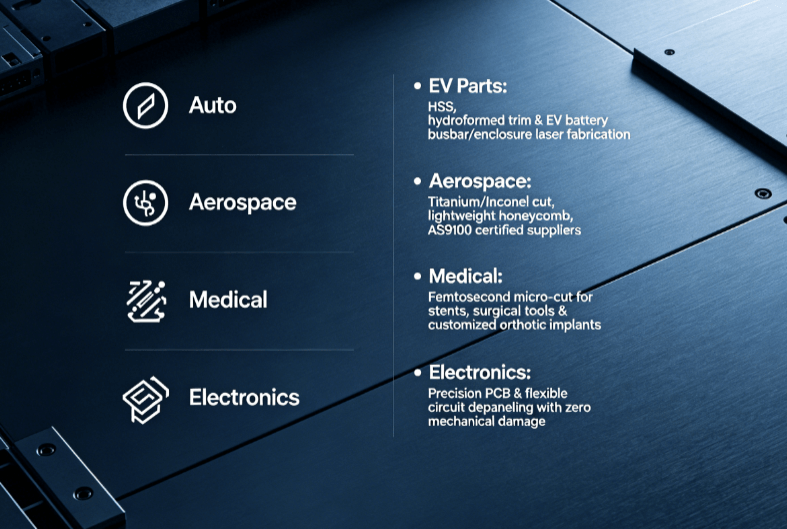
- High-Strength Steel (HSS) Cutting: Essential for safety components like A-pillars and B-pillars.
- Hydroformed Part Trimming: 3D laser cutting is used to trim complex tubular structures after they have been shaped.
- EV Battery Components: Precision cutting of busbars and battery enclosures where thermal distortion must be minimized.
2. Aerospace and Defense Requirements?
In aerospace, the focus is on material integrity and traceability. Sourcing for this sector requires suppliers who understand:
- Superalloy Processing: Cutting titanium and Inconel for engine components.
- Weight Reduction: Utilizing lasers to create honeycomb structures that maintain strength while reducing mass.
- Certification Compliance: Suppliers must often pair their laser applications with AS9100 certifications.
3. Medical Device Manufacturing Precision?
For medical buyers, the application is often "micro-cutting."
- Stent Manufacturing: Using femtosecond lasers (ultra-short pulse) to cut cardiovascular stents without creating heat-affected zones (HAZ).
- Surgical Instruments: Precise cutting of stainless steel for scalpels and forceps.
- Custom Orthotics: Rapid prototyping of implants based on patient-specific 3D scans.
4. Electronics and Semiconductors Trends?
As devices shrink, laser applications move into the realm of the microscopic.
- PCB Depaneling: Cutting printed circuit boards without mechanical stress that could damage delicate components.
- Flex-Circuit Trimming: Precision cutting of polyimide films used in foldable smartphones and wearables.
Material Compatibility: Matching RFQs to Laser Processes
A common pitfall in procurement is requesting a laser-cut finish on a material that is either incompatible or inefficient for the process. Use the following table as a quick reference for sourcing feasibility:
| Material Type | Preferred Laser Application | Sourcing Difficulty | Key Buyer Concern |
|---|---|---|---|
| Carbon Steel | Fiber (Oxygen Assist) | Low (Commodity) | Edge oxidation/Rust |
| Stainless Steel | Fiber (Nitrogen Assist) | Low | Clean, burr-free edges |
| Aluminum | High-Power Fiber | Medium | Surface scratches/Dross |
| Copper/Brass | Fiber (Beam Shaper) | High | Reflection damage to laser |
| Acrylic/PMMA | CO2 | Medium | Edge clarity (Flame polished) |
| Polycarbonate | CNC Router (Better than Laser) | High | Charring/Discoloration |
Global Sourcing Ecosystem: Navigating Manufacturing Clusters
Where you source your laser-cut components depends heavily on your volume and logistical requirements.
- China (Shenzhen, Jinan, Wuhan): The global hub for laser machine manufacturing and high-volume component sourcing. Ideal for bulk buyers and OEM projects requiring aggressive pricing. Jinan, in particular, has emerged as a specialized cluster for laser equipment and service providers.
- Germany (Stuttgart/Ditzingen): Home to high-end laser technology (e.g., Trumpf). Best for high-complexity, low-volume aerospace or medical components where precision is non-negotiable.
- Southeast Asia (Vietnam/Thailand): Rapidly growing for automotive and electronics assemblies. A strong alternative for US-based buyers looking to diversify their supply chain away from high-tariff regions.
Evaluating Supplier Capabilities: Beyond the Machine Brand
A common mistake is assuming that a supplier with a "Brand Name" laser machine (like Trumpf, Bystronic, or Amada) automatically produces better parts. From a procurement standpoint, the "application" is only as good as the operator and the workflow.
1. What Technical Workflow Matters Most?
- Nesting Software Efficiency: Ask which CAD/CAM software they use. Efficient nesting reduces material waste, which should be reflected in your raw material cost.
- Gas Delivery Systems: Do they use bulk liquid nitrogen or cylinders? Bulk systems ensure consistent pressure, resulting in more uniform edge quality across large batches.
- Secondary Operations: Laser cutting is rarely the final step. Does the supplier offer in-house deburring, bending (CNC press brake), and surface finishing? Sourcing from a "one-stop-shop" significantly reduces logistics costs and quality disputes.
- Tolerance Verification: Request a capability report (Cpk). While lasers are precise, thermal expansion can affect tolerances in thick materials.
AI and Automation in 2026 Laser Sourcing
The manufacturing world is moving toward "Lights-Out Manufacturing." In 2026, the most competitive suppliers are those integrating:
- Automated Loading/Unloading: Reduces labor costs and allows for 24/7 production cycles, which is critical for bulk buyers with tight deadlines.
- AI Vision Systems: These systems inspect parts in real-time as they are cut, identifying defects instantly and reducing the risk of a faulty batch reaching your warehouse.
- Predictive Maintenance: Suppliers using IoT-connected lasers have less unplanned downtime, ensuring that your delivery schedule remains intact.
Procurement Logic: Small Buyer vs. Bulk Buyer
Your approach to laser applications should change based on your buyer profile:
- Ecommerce Sellers / Small Buyers: Focus on "Laser Cutting Services" on platforms like Xometry or local job shops. Look for suppliers with "no MOQ" (Minimum Order Quantity) but be prepared for higher per-unit costs. Prioritize suppliers who can handle "Kitting" and individual packaging.
- Bulk Buyers / Brand Owners: Move upstream to the manufacturers. Focus on "Contract Manufacturing." Your goal is to secure dedicated machine time. Negotiate based on "Machine Hour Rate" + "Material Cost" rather than a flat per-piece price to gain transparency.
Sourcing Risks and Mitigation Strategies
Despite its precision, laser cutting has inherent risks that procurement professionals must manage:
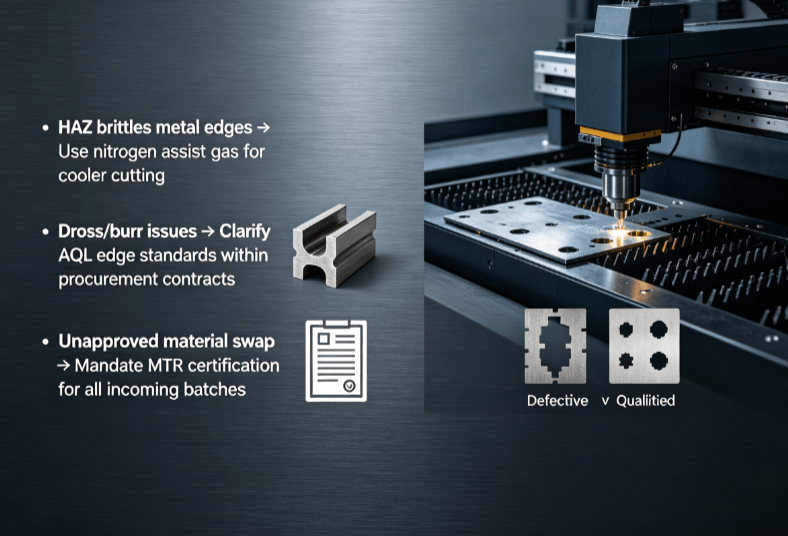
- Heat Affected Zone (HAZ): Excess heat can change the molecular structure of the metal edge, making it brittle. This is a major concern for structural components. Mitigation: Specify "Nitrogen Assist" for a cooler cut.
- Dross and Burrs: Molten metal that re-solidifies on the bottom of the cut. Mitigation: Set clear "Acceptable Quality Levels" (AQL) for edge finishing in your contract.
- Material Substitution: Suppliers using lower-grade steel than specified. Mitigation: Request Material Test Reports (MTR) with every shipment.
Summary
Before issuing an RFQ, verify these four pillars of laser sourcing:
- Material Match: Is the material thickness and type optimal for fiber or CO2?
- Tolerance Requirements: Does the part require +/- 0.05mm (standard laser) or +/- 0.01mm (precision micro-laser)?
- Volume vs. Process: Is the volume high enough to justify laser cutting, or would stamping (higher tooling cost, lower unit cost) be more economical for 100,000+ units?
- Post-Processing: Who is responsible for removing the "laser film" or deburring the edges?
Reference Sources
TRUMPF Group - Industrial Laser Technology official site.