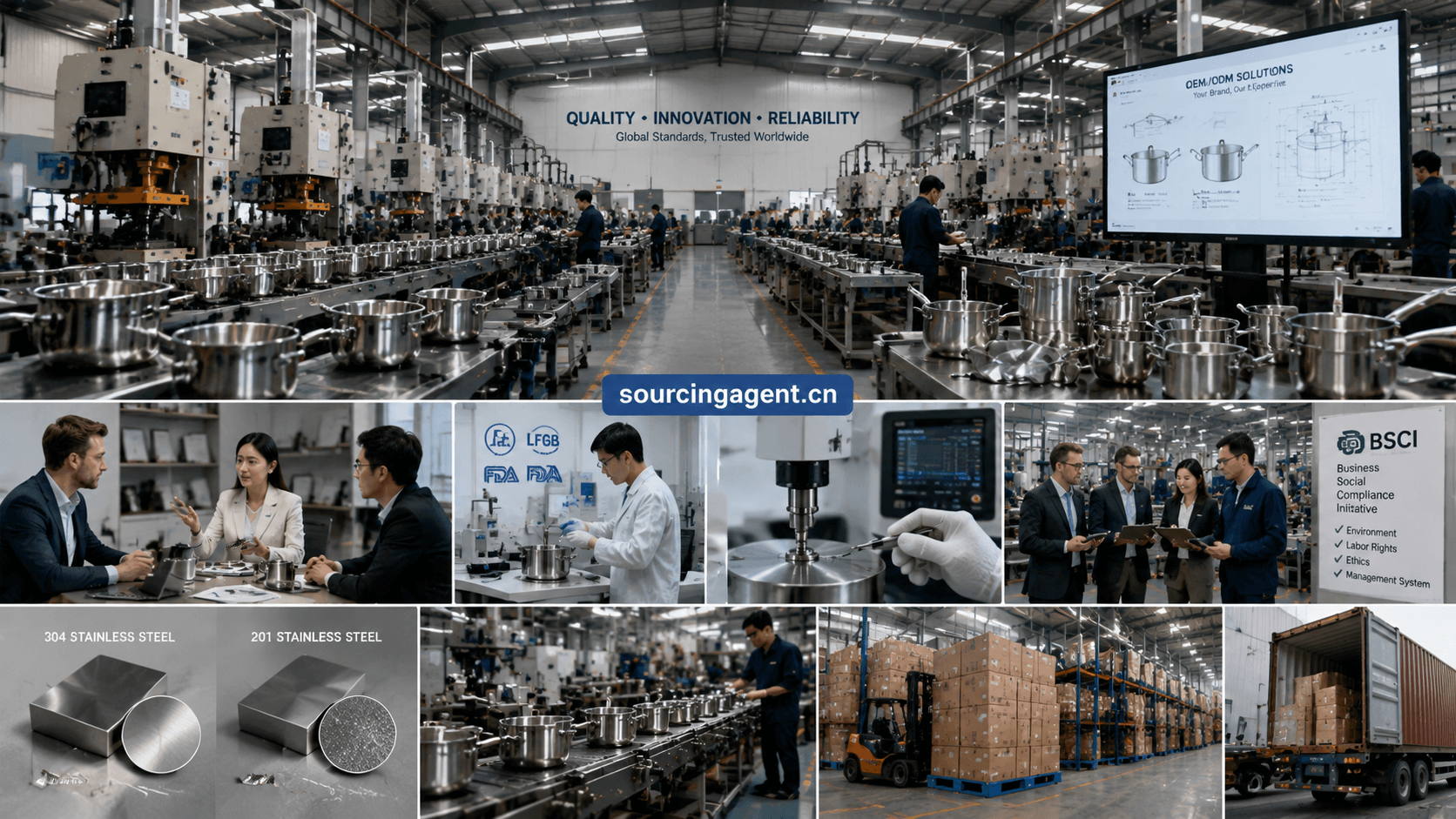
For global procurement officers and brand owners, sourcing cookware from China has evolved. While 1688.com remains a powerhouse for domestic wholesale and small-batch inventory, it often falls short for buyers requiring high-tier OEM/ODM services, international certifications (LFGB, FDA), and rigorous social compliance (BSCI).
In 2026, the "Best" manufacturer is no longer just about the lowest price per unit; it is about supply chain transparency, material integrity (304 vs. 201 stainless steel), and R&D capability. This guide moves beyond the surface-level marketplaces to identify the industry leaders and the logic of professional cookware procurement.
Why Top-Tier Buyers Look Beyond 1688 for Cookware
While 1688 is excellent for "off-the-shelf" products, professional buyers often encounter limitations in three areas:
- Material Certification: High-end cookware requires verified food-grade coatings (like Whitford or Teflon) and heavy-metal testing. 1688 listings often lack the granular documentation needed for EU or US customs.
- Customization (OEM/ODM): Modifying a handle design, bottom thickness (impact bonding), or customized packaging often requires direct engineering communication that middleman-heavy marketplaces can't facilitate.
- Compliance Audits: Large-scale retailers and brand owners require factories that pass Sedex or BSCI audits. Most 1688 sellers are trading companies or small workshops that do not invest in these certifications.
Top Cookware Manufacturers in China: The 2026 Essential List
The following manufacturers represent the "tier-one" of Chinese production, primarily located in the industrial clusters of Guangdong and Zhejiang.
1. Guangdong Linkfair Group (Stainless Steel Specialist)
Based in Yunfu, Linkfair is widely considered one of the largest stainless steel cookware manufacturers globally. They operate with a high degree of automation and focus on high-end multi-ply (3-ply, 5-ply) stainless steel.
- Best For: Premium brand owners and high-volume retailers.
- Specialization: Impact bonding, high-end stainless steel sets, and multi-ply technology.
- Sourcing Note: Expect higher MOQs (typically 1,000+ units per SKU) but world-class quality control.
2. Zhejiang Supor Co., Ltd. (The Industry Titan)
A household name in China, now largely owned by the SEB Group (France). Supor operates massive manufacturing bases across Zhejiang and Hubei.
- Best For: Bulk buyers looking for established R&D and diversified kitchen categories.
- Specialization: Pressure cookers, non-stick aluminum cookware, and small kitchen appliances.
- Sourcing Note: Their export division is highly sophisticated, handling everything from design to international logistics.
3. Sanhe Kitchenware (Aluminum & Non-Stick Expert)
Located in Ningbo, Sanhe is a leader in the pressed and forged aluminum segment. They are a major partner for global brands in the US and European markets.
- Best For: Ecommerce sellers (Amazon/Shopify) looking for trendy, high-performance non-stick lines.
- Specialization: Ceramic coatings, forged aluminum, and induction-compatible bottoms.
- Sourcing Note: Sanhe is known for its strong design team, making them ideal for ODM projects.
4. Xinhui Rixing Enterprise Ltd. (Stainless Steel Heritage)
Located in the Jiangmen cluster, Rixing has decades of experience in the stainless steel sector, focusing heavily on the export market.
- Best For: Wholesalers and mid-to-high-end brands.
- Specialization: Professional-grade stainless steel pots and pans with a focus on durability.
- Sourcing Note: They have excellent experience with Western quality standards and logistics requirements.
5. Zhejiang ASD Electric Co., Ltd.
A direct competitor to Supor, ASD is another giant in the Zhejiang cluster. They have one of the most advanced automated production lines for non-stick cookware in Asia.
- Best For: Large-scale distributors and discount retailers.
- Specialization: Die-cast aluminum, non-stick coatings, and cost-efficient mass production.
- Sourcing Note: ASD offers significant economies of scale for very large orders.
Mapping China’s Cookware Clusters: Guangdong vs. Zhejiang
Understanding where to source is as important as knowing who to source from. Cookware manufacturing in China is highly localized.
| Cluster Region | Primary Materials | Key Strengths |
|---|---|---|
| Jiangmen/Yunfu (Guangdong) | Stainless Steel | High-end finishing, multi-ply technology, professional/commercial grade. |
| Yongkang/Ningbo (Zhejiang) | Aluminum (Forged/Cast) | Cost efficiency, innovative coatings, high automation, trendy designs. |
| Yangjiang (Guangdong) | Knives & Kitchen Tools | Specialized in cutlery and kitchen accessories to complement cookware sets. |
| Linyi (Shandong) | Cast Iron | Emerging hub for traditional and enameled cast iron cookware. |
How to Evaluate a Chinese Cookware Factory: The Procurement Workflow
To move beyond the "1688 mindset," buyers should adopt a professional verification workflow.
1. Technical Specification Review
Before asking for a price, define your "Bill of Materials" (BOM):
- Base Material: 304 (18/8) vs. 201 stainless steel; 3003 vs. 5052 aluminum.
- Coating: Request specific brands like Whitford (Eclipse/Xylan), Teflon, or Greblon.
- Bottom Construction: Impact-bonded vs. brazed bottoms for induction.
2. Certification Verification
Don't just take the supplier's word. Ask for:
- Product Testing: Recent FDA/LFGB reports from third-party labs (SGS, TUV, or Intertek).
- Factory Audit: A valid BSCI or SMETA report (less than 12 months old).
3. Sample Protocol
In the cookware industry, the "Golden Sample" is everything.
- Step A: Request a proto-sample (for shape and feel).
- Step B: Request a pre-production sample (with final coating and branding).
- The Stress Test: Conduct an "egg test" for non-stick or a salt-spray test for stainless steel to check for corrosion resistance.
Logistics and Quality Control Considerations
Cookware is heavy and takes up significant volume. Your "Landed Cost" will be heavily influenced by your logistics strategy.
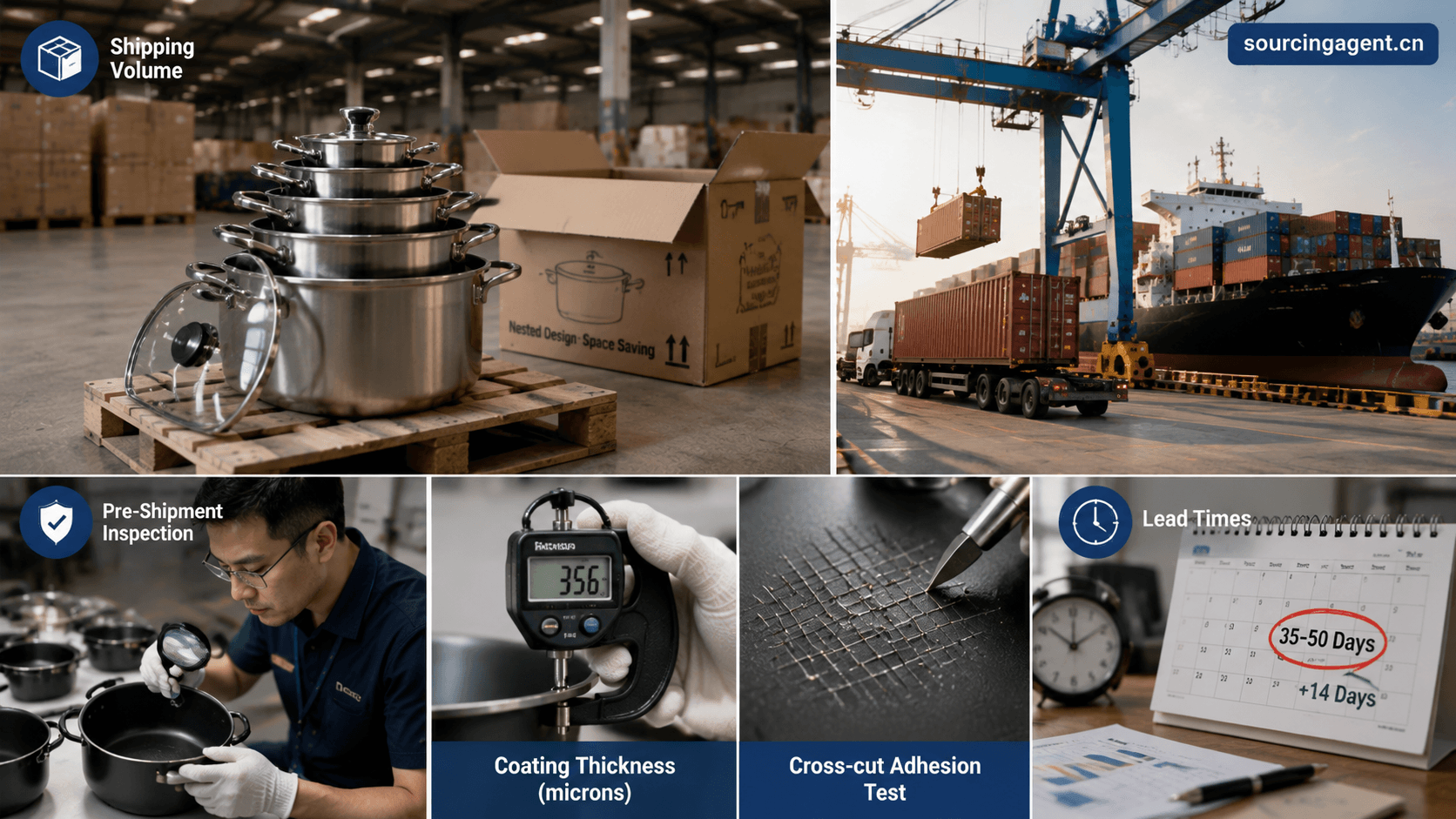
- Shipping Volume: Nested cookware sets (stacking pots inside each other) are essential for reducing shipping costs.
- Pre-Shipment Inspection (PSI): Never ship without a third-party inspection. Focus on "Coating Thickness" (measured in microns) and "Cross-cut adhesion tests" to ensure the non-stick surface won't peel.
- Lead Times: Standard production is 35–50 days. In 2026, allow an extra 14 days for shipping volatility in major global lanes.
Reference Sources:
- China Household Electrical Appliances Association (CHEAA)
- General Administration of Customs of the People's Republic of China (GACC)
- SGS Global Kitchenware Testing Standards 2025-2026
- Hong Kong Trade Development Council (HKTDC) Industry Reports